

Aging isn’t easy. What can help?
When you look in the mirror, how do you see yourself?
I certainly don’t see myself the same as I did when I was 30 years younger, 20 years, even 10 years. I know that I will continue to evolve.
It is amazing to me how some of the things I was self-conscious about as a young adult are complete non-entities now. Becoming a more mature woman has enhanced my perception of myself in many positive ways. I credit partially the journey I’ve taken from a more outward-focused interaction with my body, to a more inward journey. By focusing on how I feel, and appreciating all that my body does for me.
I also credit having supportive, body positive relationships that have helped to fuel confidence in myself.
And yet…Aging is hard.
Some days I wake up wondering, what now?? So many random (and not always random) body aches and pains! Often, by the time I figure out and heal from one thing, there is another issue cropping up immediately afterwards.
It seems to take longer to heal.
It can be just so so frustrating!
Looking in the mirror, I notice changes, in my face, my skin, my hair, my body…even my eyes look different. Who is that older woman looking at me?
In my late-forties, I’m still on the younger side of this arc of aging. I know that there is so much more to come. My students are a variety of ages, with many of them in their 50s and 60s, and we experience a lot of this frustration together.
I am so grateful to have my yoga practice and teaching as a tool for empowering myself and my students through these years. Yoga is complementary in its goal and how it can support us as we age. I’ll explain more what I mean in a bit. But first…
The Two Fountains of Youth
I believe that there are two fountains of youth for us women. We can access both in yoga and beyond.
- Muscle Tone – This is extremely important for us to maintain and continue to try to build as we age. We begin losing muscle mass and strength even in our 30s but we often notice the effects only in our 40s. Perimenopause exacerbates this process and the less we do, the worse it is. Yoga asana practice is wonderful for toning our upper and lower bodies. By using our own body weight in weight bearing poses it contributes to full body fitness. But if you have practiced yoga for a long time or practice yoga multiple times a week…it is often not enough! You need to continue to challenge and load your body for your skeletal muscles and bones to continue building. I highly recommend my students to also work out with weights and in strength training. This is not just for the muscle tone and strength, but for the health of their bones. I practice what I preach – I lift weights and find it incredible beneficial.
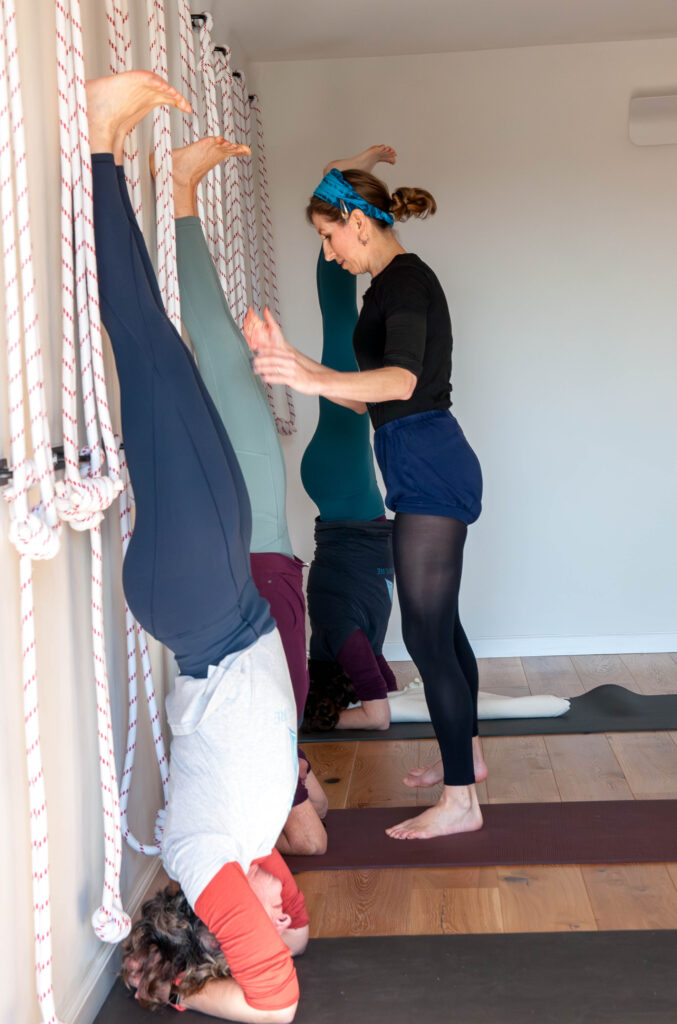
- Inversions – Reversing the aging effects of gravity through inversions. There are a variety of inversions that we practice in yoga. Of particular import are the king and queen of the asanas, Salamba Sirsasana(Supported Headstand) and Salamba Sarvangasana (Supported Shoulderstand). They stimulate the circulatory, nervous, hormonal and lymphatic systems. Properly practiced inversions are energizing, stimulating, revitalizing, balancing and soothing…all at once. This seemingly contradictory description is part of the magic of yoga in general and inversions in particular. A word of caution though before you begin. Most of us are not in the right shape to immediately begin the king and queen of inversions. I advise to move gradually, with gentle inversions like Adho Mukha Svanasana (Downward Facing Dog), Urdhva Prasarita Padasana at the wall (Legs up the Wall), and Viparita Korani with a Bolster (Legs up the Wall with a Bolster under the Pelvis) first. With the help of an Iyengar Yoga Instructor, you can safely learn the other inversions and then eventually practice them on your own for life.
Two Sides of a Coin
The practice of yoga offers a very complementary balance to a women’s perspective. This is incredibly powerful to embody as we age. Two main principles upon which yoga is based are Abhyasa and Vairagya. They are considered two sides of the same coin and must be applied in equal parts. Before I get into the definition of these terms and ideas, let’s back up a step.
The Yoga Sutras of Patanjali is an ancient text on yoga practice and theory. Sutra 1.2 lays out what yoga is…the main goal of yoga:
1.2 yogah citta vrtti nirodhah
Yoga is the cessation of the fluctuations in the consciousness.
In other words, yoga is stilling and quieting all the movement of thoughts in our minds.
By Sutra 1.12 we are offered a path to achieving this goal:
1.12 abhyasa vairagyabhyam tannirodhah
Practice and detachment are the means to still the movements of consciousness.
We see here that Abhyasa is practice (or effort) and Vairagya is detachment (or renunciation). In other words, practice will put us on the right path in order to calm the mind. Detachment from the outcome of this practice will allow us to keep traveling on this path, despite the inherent obstacles, pains and pleasures that are sure to arise. Further, Patanjali offers us some hints of what practice should look like…long, uninterrupted, devoted and enthusiastic.
I bring this up here, in the conversation around self-image, because our self-image is an image in our mind, surrounded by lots and lots of thoughts. It is essentially a lot of chatter. When our mind is quiet, when we have successfully restrained the movements of our consciousness, we become one with ourselves and we just exist. We feel connected to all the layers of ourselves. Physically, organically, intellectually, spiritually…and the image of ourself, of the “I” dissipates. It’s not even about positive self-image versus negative self-image…it is the neutrality of an image.
Even if this goal seems out of reach, the principles of Abhyasa and Vairaghya apply to the process. In fact, as I’ve matured, I try to apply these principles to everything I do. There is the effort, the practice and the work. We are very familiar with this in Western culture as the means to achieve anything. But the flip side of that coin is the detachment…the letting go. I particularly resonate with the idea of acceptance.
And here is where the principles of yoga can really support us in our aging.
Finding Balance
We must not give up the practice. Abhyasa is the devoted effort to cultivate willpower and persistence in the achievement of our goals. Maybe this is to still the mind, but it might be other goals along the way in yoga. It could be in your physical practice, working on your inversions, your home practice, etc. Yoga asana practice offers so many milestones and avenues for development; it is endless. We slow down aging and fulfill ourselves with the strengthening and purifying benefits of yoga asana and pranayama.
But we also must balance this practice. Vairaghya is the detachment that helps us to identify, learn about and ultimately let go of our fears, our desires, our aversions, our pride, and our attachments. Vairaghya is accepting where we are at this precise moment. Detached from being “good” or “bad;” detached from the process and from the fruits of the process.
The key is in the balance of these two principles. The common metaphor here is of the wings of a bird. With each even beat of the two wings, the bird is able to soar forward.
For us too, as we move forward in our lives, in how we see and relate to ourselves, we too can soar. By balancing our efforts and acceptance. Investing in our bodies and our health. By resisting the pull of gravity sometimes, but also by accepting the nature of the aging process. Loving ourselves as we are. Acceptance, appreciation and gratitude for the gift of this journey.